
The AI-Native Software Lifecycle
How product teams, engineers, and leaders must rethink development in the age of AI

For years, software development had a familiar rhythm.
Understand the problem. Break it down. Write code. Review it. Test it. Ship it. Repeat.
AI has not removed that rhythm. But it has changed the tempo of nearly every part of it.
Most people focus on the most visible change: code gets written faster. And that is true. A decent engineer with strong prompting habits and the right tools can now produce in hours what used to take a day or two. Boilerplate collapses. Refactors start faster. Alternative implementations appear instantly. Documentation, tests, and migration scripts no longer begin from a blank page.
But that is the shallow version of the story.
The deeper shift is that AI is changing the shape of the software development lifecycle, not just its speed. When the cost of producing code drops, the relative importance of everything around the code rises. Understanding the problem becomes more valuable. Reviewing becomes more demanding. QA changes form. Multitasking gets easier in some ways and more dangerous in others. Estimation gets fuzzier. And expectations, unless actively reset, become badly distorted.
The AI-native SDLC is not simply the old SDLC with more output per hour. It is a different operating environment.
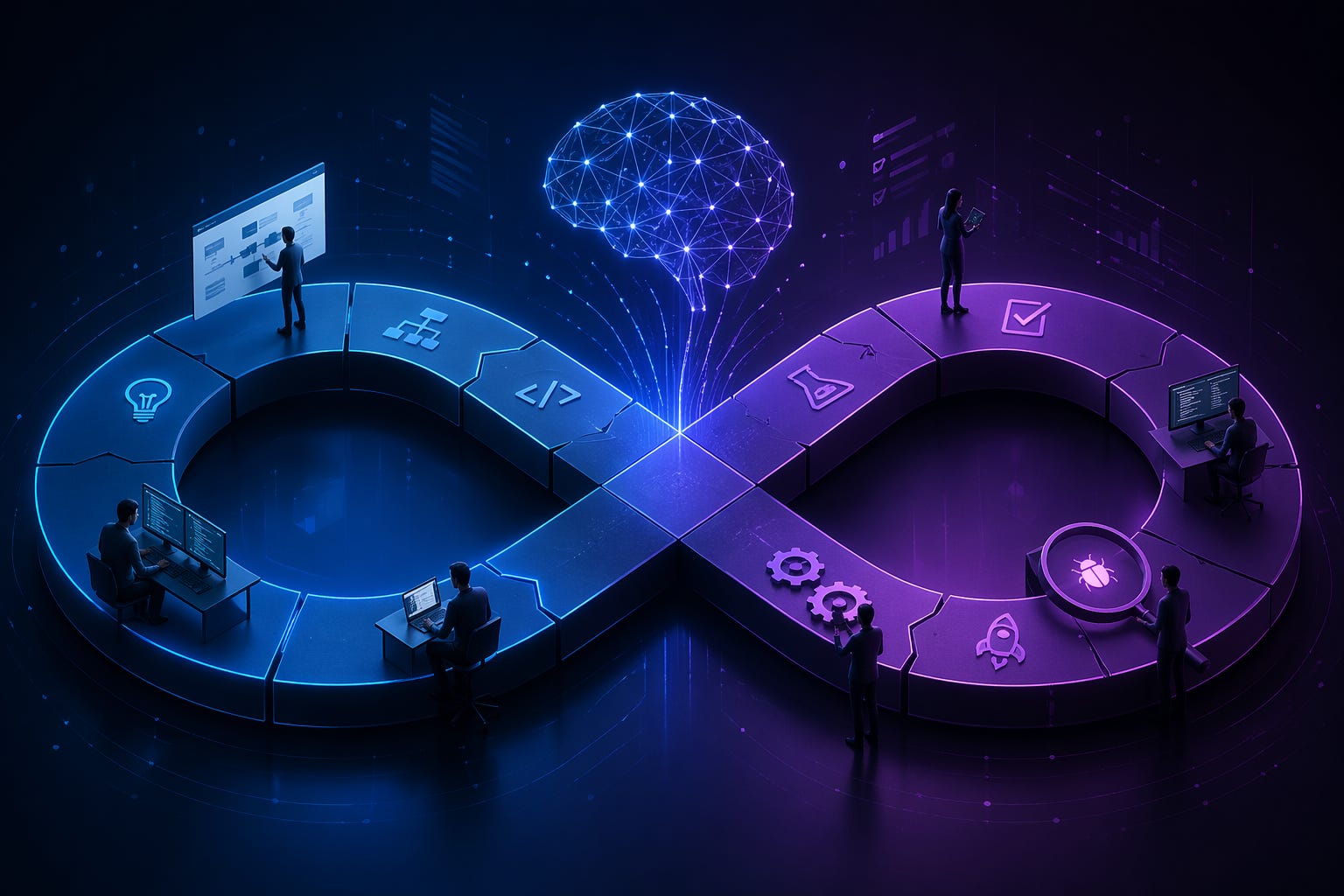
Writing code is getting faster, but that does not mean development is
AI has meaningfully compressed the time it takes to produce a first draft of software.
That matters.
A lot of engineering work used to be constrained by translation time: turning intent into syntax, stitching together patterns, wiring edge cases, finding the right APIs, scaffolding tests, and shaping the first usable implementation. AI has reduced that friction dramatically.
The bottleneck is no longer “can we produce code quickly?” Nearly every strong engineer now can.
The new bottleneck is “can we produce the right code in the right context with enough confidence to rely on it?”
That distinction matters because software development was never just a typing exercise. Code is only valuable when it fits the domain, solves the right problem, respects existing architecture, handles edge cases, and remains maintainable for the people who inherit it. AI helps with generation. It does not magically solve the fit.
So yes, code writing is getting faster. But software development, end to end, does not speed up in a linear way. In many cases, AI compresses one phase and expands the importance of the phases around it.
That is why teams feel both more productive and, at times, strangely less certain.
Code review is becoming more important, not less
One of the most underappreciated effects of AI is what it does to review.
When engineers write code manually, the volume of change is naturally constrained by their own speed. AI removes that constraint. A developer can now produce much more code in a shorter period of time, often across unfamiliar parts of the stack, and with greater confidence than the underlying understanding may justify.
That creates a new review problem.
The reviewer is no longer just checking code quality. They are checking whether the author — and sometimes the AI — truly understood the problem, the domain, the architectural intent, the hidden trade-offs, and the operational risks.
In other words, review is shifting from “is this code clean?” toward “is this systemically correct?”
That takes longer.
Or more precisely: it takes more cognitive effort, even if organizations pressure people to pretend it doesn’t.
AI-generated code is often plausible, polished, and locally coherent. That makes it dangerous in a subtle way. Bad manual code often looks bad. Bad AI-assisted code often looks good. It reads smoothly. It follows patterns. It sounds confident. But it may miss domain nuance, misunderstand the business rule, overgeneralize a pattern, or introduce invisible maintenance debt.
So while code generation gets faster, review often becomes more load-bearing. Reviewers need stronger context, sharper skepticism, and better systems for verifying intent. Teams that do not adapt their review habits will accumulate a new class of risk: code that looks production-ready before it is understanding-ready.
This also has implications for pull request size. If AI increases output volume, then large PRs become even more dangerous than before. Teams will need stronger discipline around slicing work, isolating changes, and reviewing in smaller units. Otherwise the review function simply becomes the new bottleneck — or worse, a rubber stamp.
QA shifts from catching mistakes to validating behavior
AI changes QA in a similar way.
Traditional quality assurance often had to spend significant effort catching implementation mistakes: regressions, syntax-level errors, wiring issues, broken flows, missing null checks, weak edge-case handling. AI can help reduce some of that by generating tests, suggesting edge cases, and surfacing likely failure paths earlier.
But again, the more interesting shift is not just efficiency. It is emphasis.
When code is easier to produce, the key question moves from “did we build it competently?” to “did we build the right thing, and does it behave correctly in the real world?”
That sounds obvious, but the difference matters. AI can help generate code and tests that are internally consistent while still encoding the wrong assumptions. A feature can be technically clean and still fail because the workflow is wrong, the business rule was misunderstood, or the user behavior was oversimplified.
This means QA increasingly becomes a form of behavioral verification, not just defect detection.
The best QA functions will become even more valuable because they sit at the intersection of system behavior, user intent, and real-world scenarios. In an AI-native environment, QA is not “the people who test what engineering built.” It is one of the last lines of defense against confidently generated but contextually wrong software.
The practical implication is that teams should expect more investment in scenario design, acceptance criteria, exploratory testing, and production feedback loops. If AI reduces some low-level implementation friction, then higher-level validation needs to get stronger, not weaker.
Understanding the problem space becomes a bigger differentiator
As code becomes cheaper, understanding becomes more expensive — at least in relative terms.
That is the real talent shift AI is introducing.
In the old world, strong engineers differentiated through design skill, implementation strength, debugging ability, and sustained output. Those still matter. But in the AI-native lifecycle, engineers increasingly differentiate through how well they frame problems, model the domain, ask the right questions, challenge vague requirements, and guide tools toward useful outcomes.
The value is moving up the stack.
The engineer who deeply understands the business process, the customer pain, the system boundaries, and the hidden constraints will outperform the engineer who simply knows how to produce a lot of code with AI assistance. Because once generation is abundant, judgment becomes scarce.
This has consequences for team structure and hiring.
Organizations that over-index on raw implementation speed may temporarily feel faster, but they will often accumulate confusion, review burden, and rework. The teams that benefit most from AI will be the ones that combine tool leverage with strong domain understanding. They will write less unnecessary software. They will reject more bad ideas earlier. They will ask better questions before generating anything at all.
Ironically, AI may push software development to become more deeply human in its highest-value layers: judgment, prioritization, trade-off management, and problem framing.
AI changes multitasking — and not always for the better
AI also changes the experience of parallel work.
In one sense, it makes multitasking easier. Engineers can jump into an unfamiliar codebase and get up to speed faster. They can ask for summaries, explore APIs, generate migration plans, inspect logs, draft tests, or spin up prototypes without paying the same cold-start cost as before. Context switching becomes less punishing because AI acts as an on-demand support layer.
That is real leverage.
But it also creates a trap.
Because the friction of starting work is lower, organizations may assume people can handle more streams in parallel. More tickets. More interruptions. More side quests. More simultaneous ownership. More quick asks. More “can you just look at this?” moments.
The presence of AI can make fragmented work look sustainable when it still carries a heavy cognitive tax.
What disappears is some of the mechanical burden. What remains is the cost of judgment, prioritization, trade-off awareness, and mental state switching. AI does not remove that. In some cases it makes the illusion of effective multitasking worse, because people appear responsive across many threads while depth quietly deteriorates.
So leaders need to be careful here. AI can absolutely improve throughput across mixed work. But it should not become an excuse to overload capable people. The teams that use AI well will likely become more effective at focused execution, not just more tolerant of chaos.
Ticket sizing gets harder, not easier
At first glance, AI should improve estimation. If coding takes less time, work should become easier to size.
In practice, the opposite often happens.
Why? Because the most compressible part of work is not always the most important part of work.
A ticket that looks like “three days of coding” may now be “one day of coding plus two days of clarifying assumptions, validating edge cases, reviewing generated output, and checking whether the approach fits the system.” AI compresses execution, but not uncertainty.
That makes old sizing heuristics less reliable.
Teams that estimate based on perceived implementation effort will often start seeing strange outcomes. Some tickets finish much faster than expected because AI accelerates the straightforward parts dramatically. Others remain stubbornly slow because the true work was never coding — it was ambiguity resolution, stakeholder alignment, domain interpretation, or careful validation.
This creates more variance, not less.
In the AI-native SDLC, ticket sizing should move away from “how much code do we think this is?” and more toward “how much uncertainty, coordination, and validation does this contain?”
That is a healthier model anyway, but AI makes it necessary.
Leaders should expect to revisit estimation language, planning rituals, and sprint expectations. Otherwise teams will either look inconsistent or start sandbagging to account for uncertainty that their old sizing model can no longer explain cleanly.
Expectations are rising faster than reality
This may be the most important leadership issue of all.
As soon as people see AI accelerate code generation, they update expectations. Executives expect more throughput. Product expects faster delivery. Engineers expect their peers to move faster. Everyone starts implicitly recalibrating what “normal speed” should look like.
But those expectations often anchor too heavily on code production and not enough on everything else.
Yes, AI can make a strong engineer faster. But faster at what, exactly?
Faster at prototyping? Absolutely.
Faster at boilerplate and first drafts? Definitely.
Faster at routine refactors, test generation, and code comprehension? Often yes.
Faster at resolving ambiguous requirements, understanding a complex domain, making sound architectural trade-offs, or validating behavior in messy production conditions? Not automatically.
This gap between visible acceleration and actual end-to-end acceleration is where dysfunction begins.
If leaders do not actively reset expectations, teams can end up in a bad place: more output pressure, less time for thoughtful review, weaker validation, more multitasking, and ultimately more hidden rework. AI then gets blamed for creating a mess, when the real issue was management treating partial speed-ups as universal acceleration.
The right expectation is not “everything should now be twice as fast.”
The right expectation is: some phases compress, some phases become more important, and the overall system must be redesigned accordingly.
What an AI-native SDLC actually requires
If AI is changing the lifecycle, then teams need to change how they operate inside it.
A few shifts seem increasingly important.
First, teams need to place more explicit value on problem framing. The earlier ambiguity is resolved, the more safely AI can be used to accelerate execution. Good prompts do not compensate for bad product thinking.
Second, review needs to become more intentional. Smaller PRs, stronger architectural context, better reviewer guidance, and more explicit scrutiny of assumptions will matter more than ever.
Third, QA needs to lean harder into scenario validation and real-world behavior. It’s absolutely critical that software engineers lower the burden on their QA colleagues by self-testing thoroughly. The question is not only whether the code works, but whether the workflow, rule, or decision logic matches reality.
Fourth, planning needs to account for uncertainty more explicitly. Estimation should reflect ambiguity, validation load, and coordination cost, not just implementation effort.
Fifth, leaders need to protect focus. AI can support parallel work, but it does not eliminate the cost of fragmented attention. The temptation to overload high performers will rise. That temptation should be resisted. Dedicated focus blocks for engineers are an absolute must, and managers must enable the reduction of distractions to help offset the increased cognitive load.
And finally, organizations need to redefine what great engineering looks like. In an AI-native environment, the highest leverage engineers are not necessarily the ones producing the most raw code. They are often the ones who understand the domain deeply, ask the best questions, structure work clearly, make sound decisions, and create conditions where AI can be used safely and effectively.
The future of software development is not just faster. It is more judgment-heavy.
The easiest way to misunderstand AI in software development is to reduce it to a productivity story.
It is a productivity story. But not only that.
It is also a story about shifting bottlenecks, changing skill hierarchies, evolving review burdens, new planning challenges, and rising expectations. It changes what is easy, what is scarce, and what becomes valuable.
Code is becoming cheaper.
Clarity is not.
Judgment is not.
Context is not.
Trust is not.
That is why the AI-native software lifecycle will not belong to the teams that merely generate more code. It will belong to the teams that redesign how software gets built around a world where generation is abundant, but understanding remains the real constraint.
And that may be the biggest shift of all.